
This post contains affiliate links, meaning Beachside Community Acupuncture PLLC may receive a small commission for purchases made through certain links at no additional cost to you. (In other words, you support us in a small way when you buy the products that we highly recommend and would use ourselves!) Click here to view our full disclosure policy.
One of the most common reasons that people give for not trying acupuncture is the fear of needles. This often stems from memories of getting shots or blood draws at a medical doctor's office, but an acupuncture treatment is a very different experience! The needles themselves differ from the those used in Western medicine, and the way that they are inserted is also a completely dissimilar technique.
Acupuncture Needles Are Different
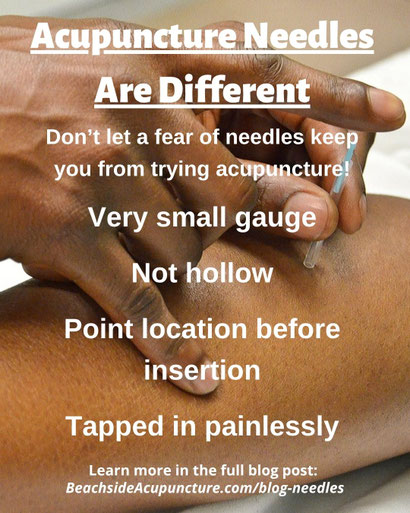
Needle thickness is measured using the Gauge system, in which a smaller gauge indicates a larger needle. The most common gauge for a routine blood draw is 21G, and the smallest syringes - say those used to inject insulin - are usually 31G. Acupuncture needles, on the other hand, are often 32G to as little as 40G, making them about the diameter of a hair.
Acupuncture needles are able to be so tiny because nothing goes in them or on them. Syringes and needles used for blood draws need to be hollow so that liquids can pass through them. The goal of acupuncture is solely to stimulate acupoints, which only requires the thinnest of needles.
Acupuncture Needle Insertion Is Different
Acupuncture needles and the needles used in Western medicine are not the same, so it makes sense that the way that they're inserted isn't the same either. The discomfort caused by a syringe can be from the puncture of the skin - again, it's a much bigger size - or from the medicine inside it being pushed into the body. A phlebotomist may need to "dig" around to find a vein for a blood draw, which is often the most uncomfortable part of the experience.
Conversely, people usually feel a very slight sensation similar to that of a mosquito bite when an acupuncture needle is inserted...or many patients are surprised that they don't feel anything at all. Although acupoints are located beneath the surface of the skin, their locations can be felt with acupressure before a needle is inserted. (No digging required!) In America, Licensed Acupuncturists almost always use small plastic guide tubes to line up where the needle will go and then quickly tap the needle in, bypassing the superficial nerve endings that register pain. If there's any discomfort, it calms down within a few seconds, and if a patient is unusually sensitive to the needles, instructions to breathe in and out help.
Western needles are removed as soon as their job is done, but acupuncture needles are retained for 20-60 minutes while the body works with them. During this time, the nervous system switches to the parasympathetic ("rest and digest") state, which is a welcome break for those living chronically in the opposite "fight or flight". Because of this, patients generally feel very relaxed and even sleepy, completely forgetting that the needles are even there.
The Best Way to Overcome the Fear of Needles
Patients often don't believe that acupuncture is painless - how can a needle not hurt??? - until they try it themselves. Over the years we've seen patients go from having a panic attack before their first treatment to looking forward to their follow-ups. Even those who continue to dislike needles find that the benefits of acupuncture are worth the temporary nervousness in the long run, and some stick with breathing techniques indefinitely to make the experience palatable (which is completely okay). Acupuncture can help with almost any medical condition; if you've been feeling stuck or hopeless in your health, look past the needles to get to feeling better!
Alternatives to Needles
Acupoints can be stimulated in other ways if someone wholeheartedly cannot overcome a negative response to needles (e.g. involuntarily fainting or persistent panic attacks at the sight of a needle). Manual acupressure, tuning forks, magnets, ear seeds... There are plenty of options out there. They may not have the same impact that acupuncture does, but they're still better than no treatment at all.

Kathleen Ketola is a Licensed Acupuncturist and the owner of Beachside Community Acupuncture. She loves providing affordable acupuncture to the residents of McKinney, Texas, and surrounding cities like Prosper, Frisco, and Melissa, but she also enjoys educating the general public on how acupuncture and Traditional Chinese Medicine (TCM) can treat everything from pain to infertility to stress and beyond. Click "Book Now" at the top of this page to book an appointment or feel free to contact her at (214) 417-2260.






Write a comment