This post contains affiliate links, meaning Beachside Community Acupuncture PLLC may receive a small commission for purchases made through certain links at no additional cost to you. (In other words, you support us in a small way when you buy the products that we highly recommend and would use ourselves!) Click here to view our full disclosure policy.
Traditional talk therapy like Cognitive Behavioral Therapy (CBT) can be very beneficial in reframing situational reactions, learning tools to work through emotions, sorting through thought patterns, and figuring out other nuances of one's conscious self. However, there's another layer of the mind that is often not accessed through talk therapy. Subconscious work requires bypassing the thinking, rational part of the brain through more specialized techniques.
Subconscious therapy is most helpful for deeply rooted beliefs. These can be related to trauma, such as in the case of PTSD or CPTSD, or just be outdated "rules" that the subconscious created from normal events that were perceived incorrectly. (The rules are set almost completely by the age of six!) Protection is the main goal of this part of the mind, but the perceptions of childhood can be inaccurate.
Subconscious blocks about self-worth, abundance, love, and other huge parts of the human experience are very common, and the following types of therapy can rework a flawed belief system.
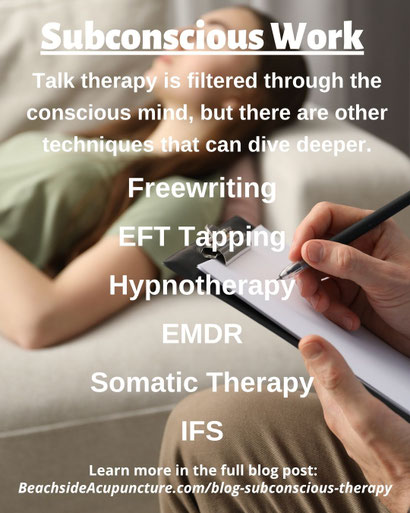
Hypnotherapy
Not like what is portrayed in Hollywood, hypnotherapy doesn't have to involve regression (reliving past experiences) and doesn't end with a person acting like a chicken or doing other ridiculous things. The first session is often an evaluation of the areas of life that seem to have limitations, which then guides the track of further appointments. During hypnotherapy, a practitioner lulls a person into a semi-conscious state similar to that of being half asleep, usually through peaceful visualization exercises. Once there, the topics of interest can be explored through gentle prompts.
The subconscious works in emotions and imagery, which means hypnotherapy can feel very abstract. The limiting beliefs may be defined in words...but they may also be let go as an emotional release, physical relaxation, or an imagined scenario. A hypnotherapist can navigate anything that comes up to bring a person to a new place of equilibrium and does not need to dig up traumatic memories in the process.
Eye Movement Desensitization and Reprocessing
EMDR, on the other hand, is best used to dampen the effects of traumatic memories. Triggering events can be stored in the mind and fester if not properly processed, and the goal of EMDR is to bring these to light in a way that both dampens their intensity and recalibrates the emotional wounds attached to them. A session often involves a bit of talking followed by the treatment itself: Bilateral stimulation - more often by holding pulsing paddles in each hand or tapping side to side than with eye movements - while recalling the target memory. The memory is then reevaluated to see if it changed (e.g. its intensity, where it's felt in the body, etc.) and the cycle repeated until the negative emotional responses can be changed to positive ones.
Internal Family Systems
IFS breaks the subconscious into distinguishable parts - each with its own strengths and weaknesses - and then retrains them to work together. In this model, parts can be pushed to extremes that cause dysregulation in the whole. By acknowledging the parts that are out of balance and working to harmonize them, a person can feel more complete and at peace.
Somatic Therapy
The term "somatic therapy" covers a wide range of modalities that use the physical body as a way to work through emotional pain. The book The Body Keeps the Score does an excellent job of explaining the various ways that trauma can be stored in the body, and areas of tension that arise from this stagnation can be used in a "bottom-up" approach to healing.
Certain types of yoga, breathwork, and dance can promote release, as can more specific techniques like Somatic Experiencing (SE) and Tension and Trauma Releasing Exercises (TRE). Somatic therapy may be incorporated into the other therapies mentioned in this post, and can even be a tool used by CBT practitioners.
A Note on Self-Work
If working with a practitioner isn't affordable or accessible, there are ways to tap into the subconscious at home:
- Journaling
- Emotional Freedom Technique (tapping)
- Visualizations (e.g. forgiveness exercises)
- Some types of meditation
There are also go-at-your-own pace programs available that dive into inner child work, shadow work, and more, but it's worth being careful with them in cases of trauma. (They may still be helpful but may not provide enough support if anything gets triggered.) Having a practitioner as a backup safety net is highly recommended as retraumatization can be very overwhelming.

Kathleen Ketola is a Licensed Acupuncturist and the owner of Beachside Community Acupuncture. She loves providing affordable acupuncture to the residents of McKinney, Texas, and surrounding cities like Prosper, Frisco, and Melissa, but she also enjoys educating the general public on how acupuncture and Traditional Chinese Medicine (TCM) can treat everything from pain to infertility to stress and beyond. Click "Book Now" at the top of this page to book an appointment or feel free to contact her at (214) 417-2260.







Write a comment