
This post contains affiliate links, meaning Beachside Community Acupuncture PLLC may receive a small commission for purchases made through certain links at no additional cost to you. (In other words, you support us in a small way when you buy the products that we highly recommend and would use ourselves!) Click here to view our full disclosure policy.
Technology has made marvelous things available to the general public. Crazy concepts from old sci-fi films are now commonplace, and it's hard to imagine that people once lived without internet, let alone without electricity and phones. Consider:
- Just a few decades ago, finding a healthy recipe involved checking out cookbooks from the library or asking friends. Now there are hundreds of variations of any given recipe available on Pinterest.
- Learning the latest research on health would mean subscribing to journals or magazines, but now an infinite amount of information is available 24/7 through computers and even phones.
Modern tech is truly amazing, making advancements across all industries, including medicine. However, for all the benefits technology offers, it can have a negative impact on health when used improperly.
Tech and Electro-Magnetic Fields (EMFs)
The body is easily conceptualized as matter; tissues like skin, muscles, and bones can be seen and felt after all. Einstein related matter to energy, and even a solid desk is actually made of vibrating atoms. In this way, every substance in the body also has some form of energy.
Beyond that, though, the body also has an overtly electrical component - think of paramedics using a defibrillator to jump start the heart of someone who has collapsed - and some members of the holistic health community fear that our constant exposure to electronics and their low-level radiation disrupts our natural biolelectricity, leading to a host of health issues.
Electromagnetic fields (EMF) are generated around electric currents, such as those running through the wires in walls, and some people say they feel physiologically different when exposed to Wi-Fi or other concentrated sources of these frequencies, experiencing headaches or fatigue for instance. The World Health Organization (WHO) has labeled EMF radiation as "possibly carcinogenic" and continues to research its effects on wellness, and while the National Institute of Health (NIH) has found no link between EMFs and cancer, documentaries like Generation Zapped are still bringing the possible health risks of prolonged exposure to the public's attention.
The only by-product of cell phones and other electronics on which everyone agrees is warmth on the skin, which doesn't sound like a huge deal, but can be in certain circumstances. For instance, many men keep their cell phones in the front pockets of their pants, very close to their testes. Exposure to heat can affect sperm production and therefore reduce male fertility, but preventing damage is as easy as not keeping phones there. Similarly, if someone is worried about other possible side effects from carrying a cell phone, simply leaving the phone on a counter, desk, etc. instead of keeping it nearby at all times can create distance.
Tech and Other Health Concerns
While the potential for radiation is controversial based on evidence so far, research has shown that common gadgets can influence health in other ways.
Sleep Disruption
The light emitted from cell phones and computer screens disrupts normal sleep cycles, as the brain mistakes it for daylight and reduces production of melatonin - the "sleep hormone" - accordingly.
Vision Issues
Extended screen time can affect vision because people tend to blink fewer times and crane their heads forward when staring at screens, leading to issues like dry eyes, blurry vision, and headaches, among others. The American Optometric Association has even given a name to this growing concern, grouping these symptoms under the term "Computer Vision Syndrome" or "Digital Eye Strain".
Attention Deficit
Psychologists have theorized that over-stimulation - through technology or other avenues - can affect the psyche. Children especially have been studied as there is no precedent in previous generations for how prolonged screen time affects their minds, but adults can suffer from this as well.
Technology can be a helpful educational tool, but if it's used simply to fill in empty space, to do something when bored, it can hinder the development of imagination in people of any age. People can no longer stand to be bored, but it is out of boredom that creativity truly shines.
Healthy Tech Habits
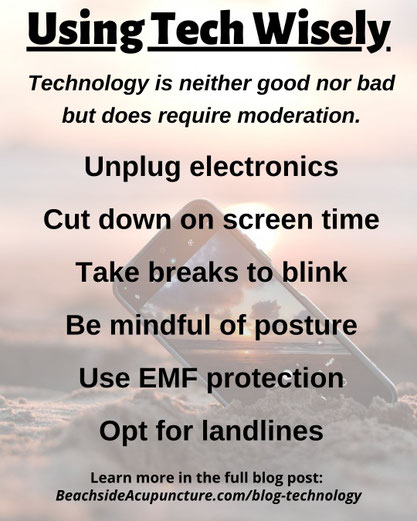
Technology isn't inherently good or bad but is something that requires moderation (like most things in life). These simple changes can bring physiological balance without reverting to living like a caveman:
- Keep electronics out of the bedroom, or at least keep them across the room where they won't be as distracting during sleep.
- Stop looking at screens an hour or two before heading to bed to avoid disrupting the circadian rhythm.
- Go outside and practice earthing to absorb negative ions and counteract the positive ions emitted by electronics.
- Take regular breaks when using the computer by going for a short walk, standing up to quickly stretch - chest expansions are especially helpful to counteract any forward lean in posture - or even just looking up at the ceiling for a few seconds.
- Blink more regularly or use eye drops to keep eyes from feeling dry when staring at screens.
- Be mindful of posture while using computers, smart phones, etc.
As for the psychological impact of technology, practice being comfortable without devices. Leave them at home every once in a while, set tech-free family time, and relearn how to enjoy moments without feeling the need to capture all of them. Don't feel guilty letting kids - or adults! - be bored, and think of more creative ways to spend time with loved ones. Actively challenge imagination, grabbing a pen and paper instead of a phone during downtime and following whatever urge comes to mind (writing, drawing, brainstorming a solution to a problem, etc.).
Back to EMFs
Although physiological effects of EMF radiation aren't substantiated scientifically, anecdotally some people seem to be more sensitive to it. It doesn't hurt to limit exposure either way.
Balance Is Key
Of course, always use common sense and be safe when it comes to technology.
- Leaving you phone at home can provide a wonderful sense of freedom...but is not a good idea if you're going somewhere new and can potentially get lost or find yourself in a dangerous situation.
- Shutting your phone off at night can lead to more restful sleep...but you should definitely keep it on if you have a sick family member who needs to be able to reach you.
- Recording everything in your life on camera can keep you from truly enjoying the present...but you'll want to capture some moments to cherish them in the future.
Find a happy balance for yourself - what works best for your situation in particular - and make use of the advancements of our modern age while still remembering to dial back and revel in the simple things as well.
This post was originally published in September of 2018 and was updated in December of 2025.

Kathleen Ketola is a Licensed Acupuncturist and the owner of Beachside Community Acupuncture. She loves providing affordable acupuncture to the residents of McKinney, Texas, and surrounding cities like Prosper, Frisco, and Melissa, but she also enjoys educating the general public on how acupuncture and Traditional Chinese Medicine (TCM) can treat everything from pain to infertility to stress and beyond. Book online or contact her at (214) 417-2260 if you'd like to schedule an appointment.







Write a comment