This post contains affiliate links, meaning Beachside Community Acupuncture PLLC may receive a small commission for purchases made through certain links at no additional cost to you. (In other words, you support us in a small way when you buy the products that we highly recommend and would use ourselves!) Click here to view our full disclosure policy.
When children draw a tongue - either as part of a smiling face or in the mouth of a dog - they usually color it pink. In reality, though, this isn't always the case. In Traditional Chinese Medicine (TCM), the tongue reflects underlying imbalances in the body, generally in a more long-term way than pulse diagnosis.
Tongue diagnosis is involved; below is a short list of what a Licensed Acupuncturist checks. (For a full list, the book Tongue Diagnosis in Chinese Medicine is very comprehensive!) Some of these can be affected by what a person did that day - e.g. coffee and colored candies can stain the tongue - but observing the same characteristics over time indicates true disharmonies.
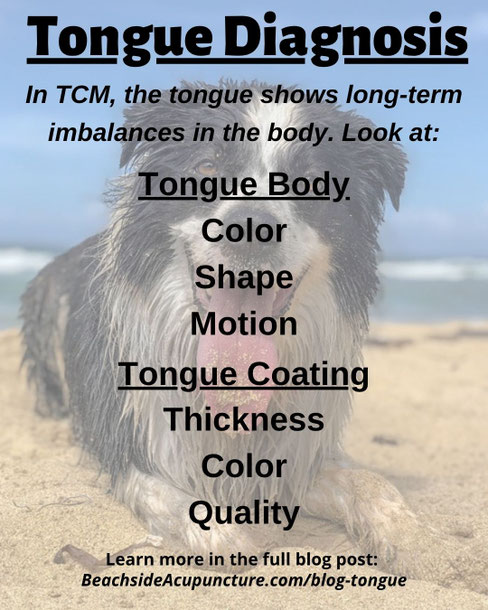
Tongue Body
A "perfect" tongue body is smooth, even, and straight without being too stiff. Its color is light red and is consistent across the whole surface, and the veins underneath it aren't dark or distended. Any variation in these aspects is usually a sign of imbalance.
Tongue Color
Tongue color is most often indicative of a Heat or Cold condition - either excess or deficient - but can be tied to Blood as well.
- Red: Heat
- Pale / white: Cold or Blood deficiency
- Dark / purple: Usually Blood stasis but can also be Qi stagnation if the color isn't too intense
- Blue (less common): Cold with Blood stasis
Tongue Shape
Tongue shape mostly correlates with states of excess or deficiency, and different shapes may be seen in different regions, creating an uneven looking terrain.
- Puffiness: Dampness or general excess
- Depressions: Deficiency
- Cracks: Usually Yin deficiency
- Teeth marks: Usually Dampness
Tongue Movement
While the tongue might start to shake if it's held out for a long period of time - it's still a muscle after all - it shouldn't move much at first.
- Quiver: Qi and/or Blood deficiency
- Deviation: Wind
- Stiffness: Heat or Wind
Tongue Coating
Excessive tongue coating can stem from imbalances in naturopathy - for instance a candida overgrowth - but in TCM all aspects of coating give information about what's going on in the body. A healthy tongue should have a thin white coat - almost to the point of being clear - equally across its entire surface.
Coating Color
- Yellow: Heat
- White: Cold
- Gray / black / brown: Chronic Heat or Cold
Coating Thickness
- Thick: Excess (usually Dampness)
- Too thin / absent: Deficiency (usually Yin)
Coating Quality
- Greasy / sticky: Dampness
- Peeled / geographic: Yin deficiency
- Dry: Deficiency of Yin, Blood, or Body Fluids
Tongue Regions
Variations in the tongue body and coating may be seen in particular areas, leading to an organ-specific diagnoses.
- Tip: Heart
- Just behind the tip: Lung
- True center: Stomach
- Sides of the center: Spleen
- Sides of the tongue: Liver
- Back: Kidney
Using Tongue Diagnosis
The tongue says a lot about a person's health, but most acupuncturists use tongue observation as a way to confirm what they already diagnosed based on answers to their questions. Two patients may have similar tongues but different symptoms, so combining both methods gives the acupuncturist more insight into what is going on with each individual.
What does this all mean for you? Take a look in the mirror: If your tongue isn't light red, with a thin clear to white coat, it may be time to book an acupuncture appointment. The tongue can show an imbalance before symptoms start to appear, so it's a great signal to start preventative treatments.
This post was originally published in May of 2017 and was updated in November of 2025.

Kathleen Ketola is a Licensed Acupuncturist and the owner of Beachside Community Acupuncture. She loves providing affordable acupuncture to the residents of McKinney, Texas, and surrounding cities like Prosper, Frisco, and Melissa, but she also enjoys educating the general public on how acupuncture and Traditional Chinese Medicine (TCM) can treat everything from pain to infertility to stress and beyond. Book online or contact her at (214) 417-2260 if you'd like to schedule an appointment.






Write a comment