
This post contains affiliate links, meaning Beachside Community Acupuncture PLLC may receive a small commission for purchases made through certain links at no additional cost to you. (In other words, you support us in a small way when you buy the products that we highly recommend and would use ourselves!) Click here to view our full disclosure policy.
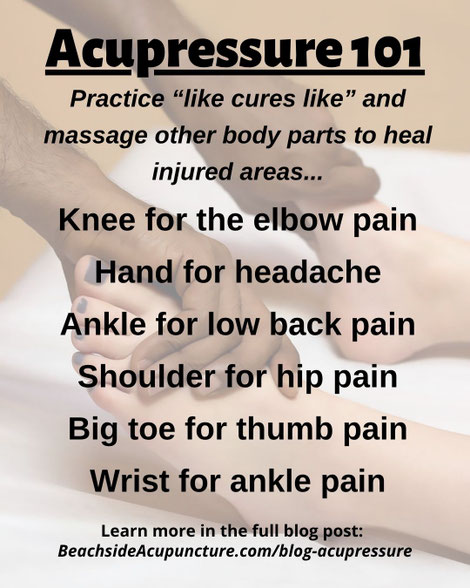
Licensed Acupuncturists insert needles into acupoints during acupuncture treatments, but anyone can practice acupressure by massaging acupoints. In fact, knowing exact point locations isn't a necessity when it comes to using acupressure for pain relief. The principle of "like cures like" found in homeopathy and other systems of holistic medicine can be applied to the body, making it easy to use other areas of the body to send circulation to an affected one. While this type of acupressure is most helpful in cases of injury where local stimulation would be painful or even detrimental, it can also be used regularly as a go-to for quick relief.
No matter where acupressure is applied, gentleness is key. There's no need to do deep tissue work or cause bruises; soft pressure or light massage is enough. Special care should be taken with pets, children, the elderly, those recovering from a serious trauma, or people who are weak and/or bruise easily.
Acupressure for Arm or Leg Pain
"Like cures like" is most easily visualized when thinking of extremities: The arm starts with a ball-and-socket joint (the shoulder) and ends with five fingers, and the leg starts with a ball-and-socket joint (the hip) and ends with five toes. The two structures are nearly identical, which means similar parts of them can be used to treat their counterparts:
- The shoulder can treat the hip
- The upper arm can treat the thigh
- The elbow can treat the knee
- The forearm can treat the lower leg
- The wrist can treat the ankle
- The hand can treat the foot
The reverse is also true, which means parts of the leg can tell the brain to send circulation to the corresponding parts of the arm. Sometimes it helps to be even more specific, for instance by massaging the inner knee for pain in the inner elbow, but the general area can also just be palpated. Sore spots can be a sign that the body is calling out for stimulation of those points, and they often make sense in meridian theory.
Acupressure for Hand or Foot Pain
When it comes to pain in the hands and feet, it's worth being more targeted with acupressure. Just like the upper and lower extremities in general, the hands and feet are comparable in their anatomy.
- The thumb can treat the big toe, the index finger can treat the second toe, etc.
- The fleshy part of your knuckle under your thumb can treat the ball of the foot
- The heel of the hand can treat the heel of the foot
The feet can also be used to work on the hands following the same logic. It's worth noting that there may be areas of the hands and feet that are sore for other reasons as both refer to other body parts in reflexology.
Acupressure for neck or Back Pain
It's easy to see how similar joints can be used to influence one another, but visualizing how to treat the back takes a bit more imagination. Little pieces of the body can be viewed as a microcosm that represent the whole. This is the principle behind reflexology on the hands and feet and behind auricular acupuncture (using acupuncture points in the ear).
When it comes to the back, the spine is a long column the connects with bigger pieces of the body at the bottom and top, meaning the pelvis and the head. Which other parts of the body are similar to this simplified structure? Really any of the long bones: The shin bone (tibia), the thigh bone (femur), the little bones that make up the flat part of the hand (metacarpal)s, etc. Either end of the bone could correspond to the "ends" of the spine - essentially neck or lower back pain - and the middle of the bone would be better for mid-back pain.
Acupressure for Headaches
If the long bones are like the spine, the hands and feet would be the bigger body parts that sit at the ends of them (i.e. the head). Many people know that the point LI4 in the meaty part of the hand works well for headaches, and in Traditional Chinese Medicine it's the "command point" for the head, treating sinus pressure, dental pain, etc. Similarly its counterpart LV3 in the foot can also be helpful for certain types of headaches.
While using "like cures like" can provide headache relief, the points listed in the Acupressure for Headaches blog post are more targeted and often have more of an impact. Some follow the same logic a step farther than what's discussed here, but others are just worth memorizing instead of learning the logic behind why they work.
**LI4 and LV3 are both contraindicated in pregnancy as they are points used to induce labor. While acupressure in general is safe during pregnancy, make sure to avoid these and GB21, UB60, and SP6.
More Advanced Acupressure
Are there other ways to affect body parts outside of this technique? Yes, probably hundreds of them...but these are the very basics. Anyone who wants more in-depth knowledge, including acupoint prescriptions for systemic issues like insomnia or indigestion, would benefit from buying a book to use as a guide. If it seems like acupressure alone isn't making a big difference, stimulating acupoints with more than just massage might have more of an impact. Of course, acupuncture treatments will always be the best!
This post was originally published in July of 2017 and was updated in October of 2025.

Kathleen Ketola is a Licensed Acupuncturist and the owner of Beachside Community Acupuncture. She loves providing affordable acupuncture to the residents of McKinney, Texas, and surrounding cities like Prosper, Frisco, and Melissa, but she also enjoys educating the general public on how acupuncture and Traditional Chinese Medicine (TCM) can treat everything from pain to infertility to stress and beyond. Book online or contact her at (214) 417-2260 if you'd like to schedule an appointment.





Write a comment